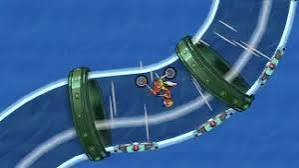
Big Air Stunts: Turn Long Jumps into Smooth Flips
Big-air sections create the longest and most exciting moments in Moto X3M Pool Party. They also give small mistakes more time to grow. A clean stunt combines a stable takeoff, deliberate rotation, constant awareness of the landing, and the discipline to stop spinning before touchdown.
Earn the airtime first
A stunt cannot succeed if the jump does not reach the landing. Build forward speed before thinking about rotation. Use the visible straight to accelerate and arrive at the ramp with the motorcycle settled. Space can add lift when the gap requires it, but extra height should support the route rather than replace proper speed.
Study the ramp shape. A steep ramp naturally raises the front and supports a backward flip. A flatter ramp creates more forward travel and may require a clearer rotation input. Understanding that starting angle helps you choose the correct direction and duration.
Start with one controlled flip
Do not hold A or D immediately for the entire jump. Press briefly after takeoff, observe the angular speed, and continue only if the bike has enough airtime. Smooth flipping comes from building rotation progressively. It should feel like guiding the motorcycle rather than forcing it.
- Confirm that the bike will clear the gap.
- Begin rotation after both wheels leave the ramp.
- Use short inputs with a visible pause between them.
- Count the rotation by watching the wheel line.
- Stop adding spin before the landing phase begins.
Use the apex as a decision point
At the top of the jump, vertical movement slows briefly. This is your best opportunity to decide whether to complete a flip, stop at one rotation, or prepare an early landing correction. Look at the road and estimate how much descent remains.
If a full rotation is nearly complete at the apex, release the control and let the bike settle. If only half a rotation is complete and the landing is close, abandon the trick and align for safety. A completed level is always more valuable than forcing a stunt beyond the available time.
Control rotational speed
Repeated input increases spin, while releasing the controls allows the game’s smooth damping to reduce it. Use the opposite direction only as a small correction. Holding the opposite key too long can start a second unwanted rotation and create a wobbling landing angle.
Backflip or frontflip?
Backflips often feel natural on rising ramps because the front wheel already points upward. Frontflips can work when a downhill landing requires the nose to drop. Choose according to the track geometry, not simply personal habit.
Land the stunt properly
- Find the landing surface before the descent becomes fast.
- Finish the main flip high in the air.
- Match the bike angle to the road slope.
- Use one final light correction if necessary.
- Resume throttle after stable tyre contact.
Both wheels do not need to touch at exactly the same instant, but their line should be close to the road. A slight rear-wheel-first landing can be safe on flat ground. A steep downhill generally prefers the front slightly lower. The important factor is avoiding a sharp frame or rider impact.
Common stunt problems
Over-rotation usually begins with holding the tilt key too long during the first half of the flight. Under-rotation often comes from starting too late. Another issue is watching the bike exclusively. Without looking at the landing, there is no reference for when to stop spinning.
Players also attempt multiple flips before mastering one. Learn a repeatable single rotation first. Additional flips are simply extensions of the same timing, but they require longer airtime and earlier planning.
Practice without wasting runs
Select one wide jump and use it as a training area. Repeat the same approach speed. On each attempt, change only the length of the first rotation press. Note where the bike reaches a full turn. Once that timing is reliable, practice releasing earlier and making a tiny final correction.
Style comes from control
The best stunt is not necessarily the one with the most rotations. A smooth arc, clearly completed flip, and stable landing looks deliberate and keeps the run alive. Prepare the jump, rotate in measured stages, and make landing alignment the final part of every trick. That approach turns Big Air Stunts from risky experiments into repeatable highlights.
Big Air questions
How many flips should I attempt?
Start with one. Add another only when the jump provides obvious spare airtime after the first rotation. Counting flips is less important than keeping enough descent time to align.
Why do I keep over-rotating?
The first tilt input is probably too long. Use a shorter press, release near the apex, and let damping reduce angular speed. An opposite correction should be brief.
Does more speed make stunts easier?
More speed increases distance and useful airtime, but it also makes the landing approach faster. Use a consistent moderate pace while learning rotation, then increase it after touchdown becomes reliable.
Measure success by complete landings rather than impressive airtime. A repeatable flip flowing into the next section is stronger than a larger trick that ends the run.
Take to the air
Practice one clean rotation, land it consistently, and then build toward bigger tricks.
Start a Stunt Run