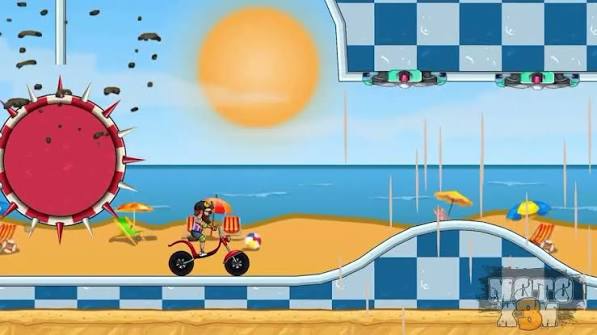
Floating Road Sprint: Find the Fastest Safe Racing Line
The Floating Road Sprint combines open speed with the pressure of racing above bright water. Its broad sections invite acceleration, while sudden slopes and narrow transitions punish riders who stop reading the track. The fastest solution is an efficient line built from visibility, timing, and calm control.
Look beyond the motorcycle
Riders often focus on the front wheel because it feels like the point of contact. That narrow view makes obstacles appear suddenly. Shift attention toward the right side of the screen, where the next ramp, dip, or barrier first appears. Early information gives you more time to adjust speed without a harsh brake.
The floating setting can make the road edge feel more dangerous than it is. Do not steer emotionally toward the center after every jump. Instead, follow the track angle and trust a balanced landing. Most lost runs come from excessive correction rather than from the road itself.
Create acceleration zones
Use the Right Arrow decisively on long straights. The goal is to reach useful speed before a ramp, not to hold maximum throttle everywhere. When the road starts to rise, decide whether the crest is visible. If the landing cannot be seen, release acceleration briefly. This small pause keeps the motorcycle responsive while preserving most momentum.
- Accelerate when the next two track features are visible.
- Coast over uncertain crests.
- Brake before a hazard, never after contact becomes likely.
- Resume throttle only when both tyres are stable.
- Save full-speed attempts until the route is familiar.
Use jumps efficiently
Space is useful for clearing low hazards or improving the path over a broken surface. In a sprint, however, unnecessary airtime can be slower than staying grounded. Wheels on the road can accelerate; wheels in the air mostly preserve existing momentum. Choose the smallest jump that safely clears the problem.
When a ramp already provides enough lift, avoid stacking a manual jump unless the gap demands it. Additional height makes the bike travel longer before it can accelerate again. A low, clean arc often produces a faster overall section than a spectacular high jump.
Balance during fast transitions
High speed exaggerates every angle. A small crest can lift the front wheel, and a downhill landing can quickly push the nose toward the road. Use short A or D inputs to align the bike, then release. Smoothness matters more than reaction speed. One controlled adjustment is better than several alternating taps.
Landing on changing slopes
Watch the direction of the road, not the horizon. If the landing descends, rotate forward slightly so both tyres meet the slope. If it rises, preserve a modest nose-up angle. After contact, allow the suspension to settle before returning to full acceleration.
A three-pass improvement method
- Discovery pass: ride at moderate speed and learn every crest, gap, and obstacle.
- Consistency pass: choose safe braking markers and complete the course without a restart.
- Speed pass: extend acceleration zones one at a time while keeping the same reliable landings.
This method is faster than repeating maximum-speed attempts because it separates route knowledge from execution. You will know exactly which section improved and which change caused a crash.
Protect momentum
Momentum is not only top speed. It is the ability to keep moving without large interruptions. Hard braking, rough landings, and excessive rotation all waste momentum. A rider who uses slightly less peak speed but avoids those losses can finish sooner than a rider who accelerates aggressively and repeatedly recovers.
Approach red hazards with enough time to choose between braking and jumping. If you jump, level the motorcycle early. If you brake, do it progressively and accelerate after the obstacle. Indecision—braking and jumping at the same instant—usually produces a short, unstable arc.
Mobile control advice
On a phone or tablet, keep the device stable and use the edges of your thumbs rather than covering the buttons with your palms. Touch controls respond immediately, so brief presses are enough for aerial balance. Landscape orientation gives the widest view of upcoming road and preserves the intended 16:9 play area.
Finish with control
The final section can tempt riders to relax or attempt an unnecessary stunt. Keep the same discipline until the finish registers. Hold speed on clear road, remain level over the final transition, and avoid adding rotation for style unless the landing area is generous.
The Floating Road Sprint rewards awareness more than recklessness. Read farther ahead, divide the route into clear acceleration zones, keep jumps low and useful, and protect momentum through every landing. When those habits connect, the track feels genuinely fast without becoming chaotic.
Floating Road Sprint questions
Is jumping always slower?
Not always. A short jump can clear a hazard or smooth a broken section, but unnecessary high airtime removes chances to accelerate. Compare both routes and keep the one with the most stable exit.
Where should I focus on a small screen?
Keep the bike in peripheral vision and focus mainly on road entering from the right. Landscape mode provides more preview distance, while brief thumb presses stop the controls from hiding important details.
How do I know when to brake?
Select a repeatable visual marker before each difficult feature. Brake there, release before takeoff, and adjust the marker slightly on the next run. Reference points are more reliable than reacting to fear.
A strong sprint combines calm acceleration with short planned control phases. A stable motorcycle spends less time recovering and preserves more average speed across the route.
Race the floating road
Use your next run to map the course first, then turn that knowledge into speed.
Start Racing