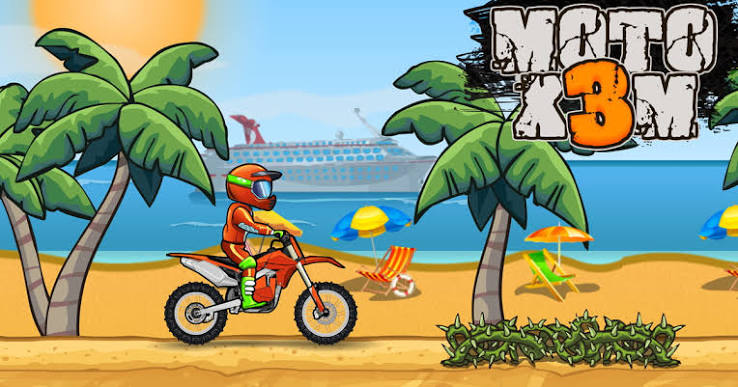
Turbo Water Track: Build Speed Without Losing Control
The Turbo Water Track is where Moto X3M Pool Party teaches its most useful lesson: speed only becomes an advantage when the rider can control it. The bright pool setting and open road encourage full acceleration, yet every ramp, slope, and landing asks for a measured response.
Understand the rhythm of the track
This course feels fast because several sections flow into one another. A downhill run feeds a ramp, the ramp creates airtime, and the landing immediately prepares the next obstacle. Instead of treating these as separate moments, read them as one continuous sequence. Look beyond the front wheel and identify where the road rises, where it falls, and where a red hazard may interrupt your line. Planning one move ahead prevents rushed corrections.
The safest approach is to divide the track mentally into acceleration zones and control zones. Long, flat surfaces are ideal for building momentum. The final section before a jump is usually a control zone, even when it looks clear. A brief release or light brake there can produce a much cleaner flight than entering at maximum speed.
A practical speed strategy
Accelerate progressively
Hold the Right Arrow to begin moving, but watch how quickly the motorcycle responds. Progressive acceleration keeps both wheels settled and gives you time to understand the upcoming surface. When the track opens, hold the throttle longer. When the camera reveals a ramp or narrow landing, reduce your input early rather than braking at the edge.
- Use full acceleration on long, visible straights.
- Release the throttle before blind crests.
- Tap the Left Arrow to reduce speed without destroying all momentum.
- Keep enough pace to cross water gaps safely.
- Avoid changing speed sharply while the bike is already rotating.
Jumping with purpose
Space provides a controlled jump, but it works best when used for a reason. Jump to clear a hazard, improve the angle over a crest, or reach a platform that normal momentum cannot reach. Random jumps make the course harder because every takeoff creates another landing that must be managed. Before pressing Space, check that the road ahead offers enough room and that the bike is reasonably level.
Speed changes the shape of a jump. At low speed, the bike travels upward more than forward. At high speed, the same input creates a longer arc. This is why a successful jump begins several seconds before takeoff: your throttle and brake choices determine the distance long before the wheels leave the road.
Smooth flips and stable landings
Use A and D, or the available tilt controls, to rotate while airborne. Start with short presses. Holding a rotation key for the entire flight usually creates more spin than the landing can absorb. The goal is not simply to complete a flip; it is to finish the rotation early enough to align both wheels with the road.
- Leave the ramp with the bike close to the ramp angle.
- Apply a short rotation input near the highest part of the jump.
- Release the key and observe the remaining rotation.
- Use a small opposite correction if the front or rear wheel drops too far.
- Match the bike to the slope and let both tyres absorb the landing.
Common mistakes to avoid
The most common mistake is holding acceleration because the word “Turbo” suggests nonstop speed. That creates overshoots, hard nose-first landings, and collisions with hazards that appeared too late. Another mistake is correcting a flip repeatedly. Fast left-right changes make the bike unstable. Use one deliberate input, pause, and then make a smaller correction.
Players also lose runs by focusing only on the timer. A smooth run is usually faster than an aggressive run with restarts. Learn the course at a controlled pace, note the safest takeoff points, and then increase speed section by section. Consistency creates better times naturally.
A repeatable practice routine
On the first attempt, finish without chasing stunts. On the second, identify two straights where more acceleration is safe. On the third, practice one controlled flip on the widest jump. Finally, connect those improvements into a complete run. This routine builds reliable muscle memory and makes progress easy to measure.
The Turbo Water Track rewards a calm rider. Build speed where the road allows it, reduce speed before uncertainty, jump with a clear purpose, and finish every stunt by preparing the landing. Once those habits feel automatic, the course becomes less like a collection of obstacles and more like a smooth, satisfying racing line.
Turbo Water Track questions
Should I hold acceleration for the entire level?
No. Continuous throttle works on clear straights, but releasing it before hidden crests provides reaction time. Fast laps come from useful speed, not from holding one input regardless of the road.
When is a flip worth attempting?
Choose a wide jump with a visible landing and enough airtime to finish rotation near the apex. If the landing is narrow or followed by a hazard, remain neutral and protect the run.
How can I become faster without crashing more?
Improve one acceleration zone per attempt. Keep successful braking and landing markers unchanged, extend the throttle slightly on one known straight, and compare the result. Small repeatable gains produce a stronger time than a full-speed attempt based on luck.
On mobile, use landscape mode and short touch presses. On desktop, keep one finger ready for Space and use A or D only when clearly airborne. Relaxed inputs make the smooth physics easier to read.
Ready to ride?
Return to the game, apply the rhythm above, and turn controlled momentum into your fastest Turbo Water Track finish.
Play Moto X3M Pool Party